Colorado Springs sits at the edge of the Great Plains against the Front Range uplift, where the Pierre Shale and underlying Dawson-Arkose formations create one of the most demanding retaining wall design environments in the Rocky Mountain region. The city's average elevation of 6,035 feet brings freeze-thaw cycles that attack wall backfill from October through April, while Site Class D soils dominate the valley floor according to USGS shear-wave velocity mapping. Any retaining wall design in Colorado Springs must account for expansive claystone bedrock, collapsible loess deposits along the Monument Creek corridor, and the city's Seismic Design Category C classification under ASCE 7-22. The geotechnical team runs laboratory programs that include consolidated-drained triaxial tests on undisturbed samples and swell-consolidation tests to quantify lateral earth pressures that standard Rankine theory cannot capture in these materials. Backfill drainage design becomes critical where perched groundwater appears at depths as shallow as 8 feet in the alluvial terraces east of downtown, and we integrate slope stability analysis when walls exceed 12 feet or when the retained slope angle exceeds 2H:1V.
Collapsible loess in Colorado Springs can generate lateral pressures up to 3 times the active earth pressure when saturated — standard Rankine assumptions fail here.
Technical details of the service in Colorado Springs
Risks and considerations in Colorado Springs
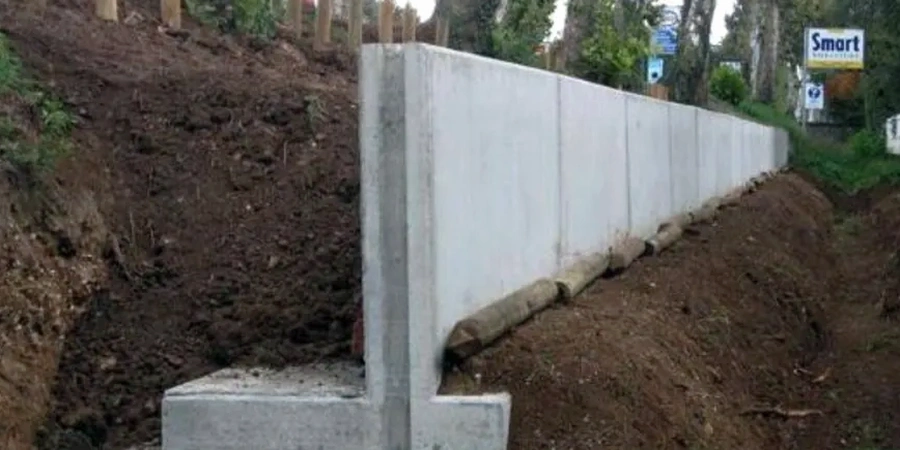
The most frequent and costly mistake we investigate in Colorado Springs is designing cantilever retaining walls with a fixed-base assumption on weathered Pierre Shale without verifying the actual bedrock competence. The shale's bedding planes dip gently eastward at 2 to 5 degrees, and when a wall excavation exposes these planes parallel to the slope face, the passive resistance wedge can slide along clay-filled discontinuities that standard bearing capacity equations miss. We have documented wall rotations exceeding 3 inches at the top of 10-foot cantilever walls within two freeze-thaw seasons when this mechanism was not identified during the site investigation phase. A proper retaining wall design for Colorado Springs must include exploratory borings extending at least 1.5 times the wall height below the proposed footing elevation, logged by a geologist familiar with the local stratigraphy, and supplemented with laboratory direct shear tests on samples oriented along bedding planes to capture the anisotropic strength envelope.
Our services
The retaining wall design process in Colorado Springs integrates field investigation, laboratory testing, and structural analysis calibrated to the specific geologic conditions of the Pikes Peak region. Each service component addresses a distinct failure mechanism relevant to local soils and loading conditions.
Site investigation and soil characterization
Drilling program with SPT sampling and Shelby tube recovery at wall alignment, logged per ASTM D2488 with focus on identifying collapsible loess, expansive shale, and perched water. Laboratory testing includes moisture content, Atterberg limits, grain-size distribution, and swell-consolidation per ASTM D4546.
Earth pressure and stability analysis
Calculation of active, at-rest, and passive earth pressures accounting for backfill compaction effects and seismic increment per Mononobe-Okabe method. Global stability checked using Spencer's method for walls with sloping backfill or surcharge loads, with factor of safety exceeding 1.5 for static and 1.1 for seismic conditions.
Drainage and backfill specification
Design of chimney drains, weep holes, and blanket drains sized for the 100-year storm event per Colorado Springs Drainage Criteria Manual. Backfill gradation specified to prevent fines migration into drain aggregate, verified through filter compatibility analysis using Terzaghi's criteria.
Construction-phase testing and observation
Compaction testing of backfill lifts using nuclear density gauge calibrated to sand cone per ASTM D1556. Observation of foundation subgrade to confirm bedrock competence matches design assumptions, with plate load tests performed when bearing capacity verification is required by the City.
Quick answers
What retaining wall design requirements does Colorado Springs enforce for walls over 4 feet?
The City of Colorado Springs requires a stamped engineering design for any retaining wall exceeding 4 feet in height measured from the bottom of footing to top of wall. The design must include a geotechnical report with soil bearing capacity, lateral earth pressure parameters, and global stability analysis. Walls supporting surcharge from structures or slopes steeper than 2H:1V require additional slope stability verification. The Pikes Peak Regional Building Department reviews all retaining wall designs as part of the building permit process.
How do collapsible soils affect retaining wall design in Colorado Springs?
Collapsible loess deposits common along the Monument Creek drainage and eastern terraces undergo sudden volume reduction when wetted, generating lateral pressures that can exceed three times the active earth pressure used in conventional design. Our laboratory measures collapse potential per ASTM D5333 on undisturbed samples. When collapse potential exceeds 5%, we specify pre-wetting of the backfill zone, over-excavation and recompaction, or design the wall for an elevated at-rest earth pressure condition with a lateral pressure coefficient Ko approaching 0.7 to 0.9 depending on the degree of saturation anticipated.
What is the cost range for retaining wall design in Colorado Springs?
How do you address freeze-thaw effects on retaining walls in this climate?
Colorado Springs averages over 160 freeze-thaw cycles annually, and the frost penetration depth reaches 36 to 42 inches per El Paso County code. We specify footing embedment below this frost depth and require free-draining backfill material with less than 5% passing the No. 200 sieve to prevent ice lens formation behind the wall. Weep holes are designed with a minimum diameter of 4 inches and spaced no more than 8 feet on center, with a filter fabric wrap that prevents fines migration while remaining permeable under freezing conditions.