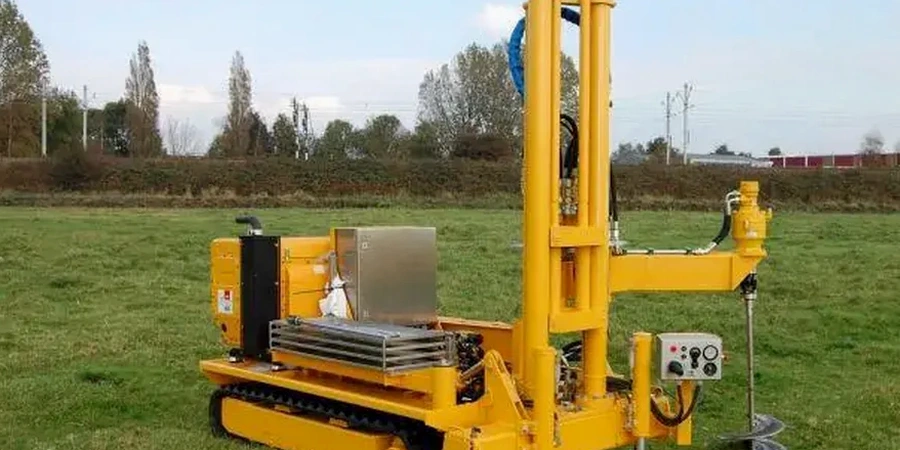
At 6,035 feet above sea level, Colorado Springs sits on a complex mix of weathered Pikes Peak granite, colluvial fans, and swelling claystone. The 2013 Waldo Canyon burn scar reshaped drainage patterns across the west side, and every new build from Briargate to Old Colorado City now faces variable fill and debris-flow deposits. A standard drilling program can miss thin silt seams or loose lenses that control settlement. The cone penetration test — CPT — captures these layers continuously, logging tip resistance and sleeve friction every few centimeters. Our team runs truck-mounted and crawler rigs throughout El Paso County, combining CPT with spt drilling where gravels exceed 50 mm and refusal is likely, and with MASW to tie the near-surface stratigraphy to a site-specific Vs30 profile.
CPT maps the thin bentonite seams in the Dawson Arkose that control slope stability — layers too fine for a split spoon to catch.
Technical details of the service in Colorado Springs
Risks and considerations in Colorado Springs
ASCE 7-22 places Colorado Springs in a region where seismic demand coexists with moderate to high shrink-swell hazard. Section 1803 of the 2021 IBC requires soil classification down to a depth that captures seasonal moisture variation — often 15 feet or more in the local claystone. A CPT log that misses a thin silt lens at 12 feet can lead to differential heave, cracked slabs, and litigation. Continuous pore-pressure dissipation tests during the sounding also quantify the consolidation coefficient directly, rather than estimating it from index tests. On hillside lots along Cheyenne Boulevard or near Austin Bluffs, the cone refusal depth marks the top of competent bedrock, letting the structural engineer place drilled piers precisely without over-excavating.
Our services
The CPT program in Colorado Springs is configured for the Front Range geotechnical environment. Each scope adapts to access, depth, and the specific design question.
Piezocone (CPTu) for Foundation Design
Full qc, fs, u2 logging with dissipation tests at clay contacts. Delivers undrained shear strength, overconsolidation ratio, and equivalent SPT N60 for bearing capacity and settlement analysis in the Dawson Arkose and Pierre Shale.
CPT-Based Liquefaction Screening
Continuous sleeve friction ratio combined with normalized tip resistance per Robertson (2009) and Boulanger & Idriss (2014). Trigger analysis for the mapped Quaternary alluvium along Monument and Fountain creeks, where a 2475-year event can mobilize loose sand at shallow depth.
Quick answers
What depth can a CPT rig reach in Colorado Springs soils?
Most soundings in the Colorado Springs area reach 15 to 30 meters before hitting refusal on gravel lenses or hard shale. The Dawson Arkose and weathered granite can stop the cone shallower on the west side, while the alluvial valleys near Fountain Creek allow deeper penetration. The field engineer monitors tip resistance in real time and stops when qc exceeds 50 MPa consistently.
How much does CPT testing cost in Colorado Springs?
Is CPT better than SPT for the expansive clays here?
CPT and SPT answer different questions. For the overconsolidated Pierre Shale and Dawson Arkose, CPT gives a continuous strength profile and can identify thin bentonite seams through the friction ratio and pore pressure response — something a standard split spoon at 5-foot intervals often misses. SPT is still valuable where gravel or cobbles cause early refusal, so the two methods complement each other.
Can CPT be done on steep lots near the foothills?
Yes. Crawler-mounted CPT rigs work on slopes up to 30 degrees and fit through 8-foot access gates, which is common for hillside lots in the Broadmoor and Cheyenne Cañon areas. For extreme terrain where even a crawler cannot level, we coordinate with a drilling contractor to run SPT borings instead.