A lot of contractors in Colorado Springs assume a few passes with a smooth-drum roller will handle loose backfill. Then the slab cracks six months later. Vibrocompaction design is not a commodity service—it requires a real understanding of how alluvial fans and decomposed granite respond to vibratory energy. We design densification programs that match the particle-size distribution of your site, not a generic chart from a manual. The subsurface conditions along the Front Range vary sharply over short distances, and what worked in Briargate may fail completely down near Fountain Creek. Before mobilizing any equipment, we run the grain-size curves and SPT data to confirm that vibrocompaction is actually the right fix—sometimes a stone column solution makes more sense when fines exceed 15 percent.
Loose granular soils don't fix themselves. A proper vibrocompaction design gives you a measurable density increase that shows up in SPT and CPT logs—not just a feel-good vibration pass.
Technical details of the service in Colorado Springs
Risks and considerations in Colorado Springs
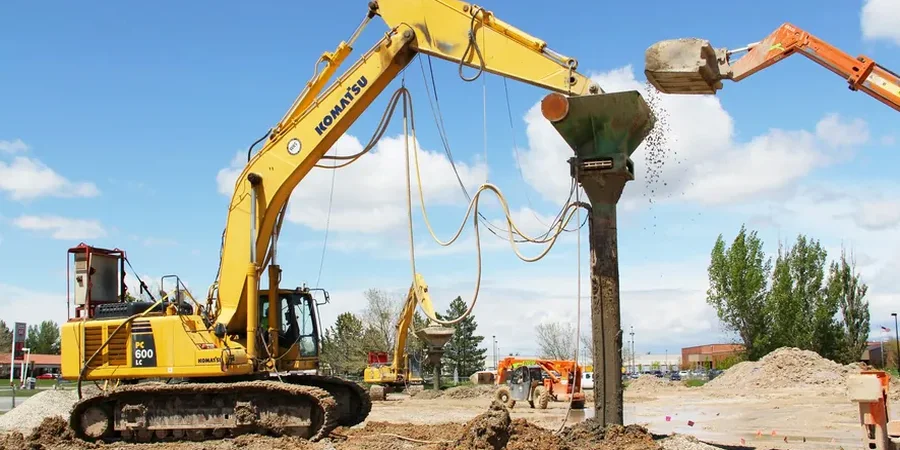
Colorado Springs sits at the base of Pikes Peak, where flash floods and rapid snowmelt can saturate the ground in a matter of hours. If your vibrocompaction design doesn't account for post-treatment saturation collapse potential, you're in trouble. We've seen sites where dry densification looked great on paper, but the first heavy monsoon cycle caused differential settlement of over an inch. The semi-arid climate here means soils often have a moisture content well below optimum when treated, and that changes the entire densification response. Our designs include wetting-up protocols and, in critical cases, post-treatment inundation tests to verify that the density holds when the ground gets saturated. The proximity to the Rampart Range fault system adds another layer—loose granular soils in a seismic event can lose strength rapidly. We tie every vibrocompaction design to the site-specific seismic hazard classification from the USGS and ASCE 7-22, ensuring the improved ground meets the required factor of safety against liquefaction.
Our services
Our vibrocompaction design package in Colorado Springs covers everything from feasibility assessment through QA/QC acceptance. We tailor each deliverable to the specific soil profile and structural demand—no boilerplate reports.
Feasibility and Soil Suitability Screening
Grain-size analysis and fines content evaluation to determine if vibrocompaction is viable. We run hydrometer tests and Atterberg limits to flag problematic soils before any equipment shows up.
Densification Program Design
Probe grid layout, depth specification, amperage targets, and backfill gradation requirements. Includes influence radius calculations and settlement estimates for the proposed pad.
QA/QC and Acceptance Testing Plan
Pre- and post-treatment SPT or CPT comparison, with statistical analysis of density improvement. We set pass/fail criteria tied directly to the structural engineer's bearing capacity and settlement requirements.
Liquefaction Mitigation Verification
Post-treatment evaluation of factor of safety against liquefaction using NCEER semi-empirical procedures. We correlate improved SPT N-values to cyclic resistance ratio for the design earthquake.
Quick answers
What soil types in Colorado Springs are suitable for vibrocompaction?
Clean sands and gravels with less than about 15 percent fines by weight respond well. The terrace deposits up on the Palmer Divide and the coarser alluvial fans west of I-25 are usually good candidates. If your site has silty sands or clay layers, we'll need to consider stone columns or rigid inclusions instead. We always run a full gradation analysis before recommending vibrocompaction.
How deep can vibrocompaction treat?
Most of our Colorado Springs projects target depths between 10 and 45 feet. Deeper treatment is possible with modular probe extensions, but cost goes up and the influence radius at depth needs careful verification. For shallow commercial pads, 15 to 25 feet is typical and cost-effective.
What does vibrocompaction design cost in Colorado Springs?
How do you verify the ground is actually densified after treatment?
We compare pre-treatment and post-treatment SPT blow counts or CPT tip resistance at the same locations and depths. The acceptance criteria are set in the design phase—typically a minimum relative density of 70 to 75 percent, or a specified N-value improvement factor. We also monitor amperage during treatment as a real-time indicator of densification energy.