Colorado Springs grew from a resort town at the base of Pikes Peak into a sprawling Front Range city, but its subsurface never stopped being a puzzle. The geology shifts fast here: shallow bedrock on the west side, deep alluvial deposits near Fountain Creek, and pockets of swelling clay that have cracked more than a few slabs over the decades. An exploratory test pit cuts through the guesswork. Instead of relying solely on borehole logs, our team opens a direct window into the ground, allowing the engineer to see stratification, moisture conditions, and the real contact between fill and native soil. For foundation design, utility routing, or forensic investigation after movement, that visual confirmation combined with undisturbed sampling is worth more than any indirect method. The IBC and local Pikes Peak Regional Building Department requirements make it clear: when soil variability is high, direct observation matters. We complement the physical exposure with grain size analysis to classify the material and Atterberg limits testing when clay layers appear, giving the full picture needed for a defensible geotechnical report.
If you cannot see the soil structure with your own eyes, you are designing on an assumption. Test pits turn assumptions into verifiable stratigraphy.
Technical details of the service in Colorado Springs
Live process video
Risks and considerations in Colorado Springs
The Dawson-Arkose and Denver Basin formations that underlie much of Colorado Springs contain expansive claystone beds that swell dramatically with seasonal moisture change; the swell pressure can exceed 5,000 psf in places, enough to lift a lightly loaded slab. A test pit reveals these clay layers directly: you can see the slickensides, the mottled coloring, and the desiccation cracks that tell you the soil is active. If you skip this step and rely on a handful of SPT samples from a drill rig, you risk missing a thin but highly expansive seam that sits right at footing depth. The cost of that oversight is helical piers, underpinning, or complete foundation replacement within a few wet-dry cycles. Our excavation approach also identifies old trash pits, buried topsoil, and undocumented fill that plague older neighborhoods near downtown Colorado Springs, where historical maps do not match what is actually in the ground. For sites near the Fountain Creek floodplain, we correlate test pit observations with liquefaction assessment data to evaluate whether loose saturated sands might mobilize during a seismic event on the Rampart Range fault.
Our services
Every test pit excavated in Colorado Springs is incorporated into a laboratory workflow that converts field observations into engineering parameters. The following services are commonly executed alongside exploratory test pits to develop a comprehensive geotechnical model:
Stratigraphic Logging and Photography
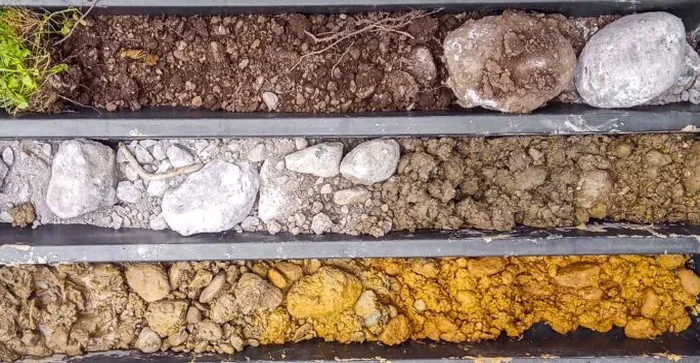
Each pit wall is logged in full color with scale reference, noting layer boundaries, moisture condition, and structural features such as fissures or shear planes. The log is the permanent record used by the design engineer.
Undisturbed Block Sampling
We extract intact soil blocks from the pit wall for laboratory strength testing, preserving natural structure and moisture. This method avoids the disturbance introduced by split-spoon samplers.
In-Situ Density and Permeability Testing
Direct measurement of field density at the pit floor using sand cone or drive cylinder, plus falling-head permeability tests in the pit when groundwater or seepage is encountered.
Quick answers
How deep can an exploratory test pit go in Colorado Springs soils?
Standard depth with a backhoe or mini-excavator is 10 to 12 feet. Deeper pits are possible with benching or sloping per OSHA 1926 Subpart P, but beyond about 14 feet, a drill rig becomes more practical for most sites. The limiting factor is often the reach of the excavator arm and the stability of the excavation walls, especially in sandy zones near the Fountain Creek drainage where sloughing can occur.
What does an exploratory test pit cost in Colorado Springs?
Do I need a permit to dig a test pit on my property in Colorado Springs?
The excavation itself generally does not require a building permit, but you must contact the Utility Notification Center of Colorado (811) at least three business days before digging to locate underground utilities. If the pit is within the public right-of-way or in an area with known archaeological sensitivity, additional approvals from the City of Colorado Springs or the State Historic Preservation Office may apply.