Colorado Springs sits at 6,035 feet, where the transition from weathered Pierre Shale to granular alluvium creates abrupt bearing capacity shifts across a single lot. The 2023 El Paso County permit data shows 2,700 new residential units started that year, many on spread footings sized from presumptive values that ignore the shale’s swelling potential. The IBC requires a site-specific investigation before accepting the 1,500 psf default, and our shallow foundation design work starts there—with a subgrade characterization that ties allowable bearing pressure to seasonal moisture variation measured on your parcel. For sites where the upper soils are marginal, footings design often integrates a gravel key to intercept water migration before it reaches the bearing stratum.
Presumptive bearing values in the IBC are a starting point, not a substitute for a site-specific subgrade modulus derived from local moisture-conditioned samples.
Technical details of the service in Colorado Springs
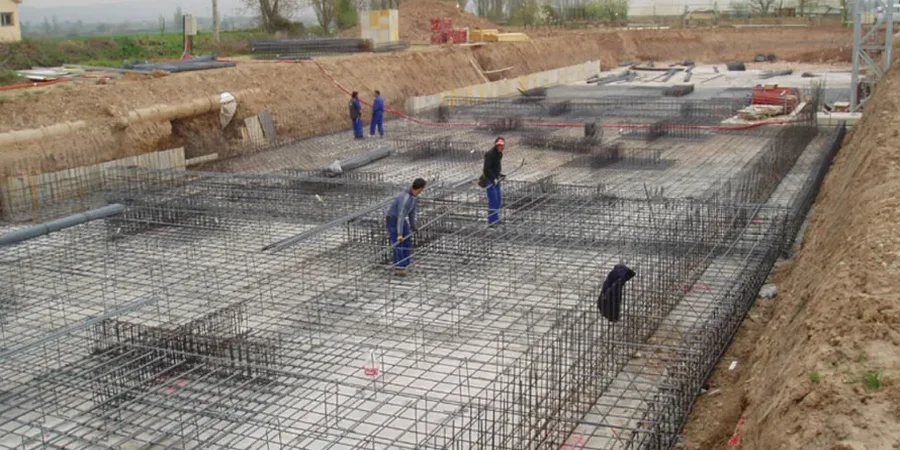
Risks and considerations in Colorado Springs
The Pierre Shale under much of Colorado Springs contains montmorillonite, and when moisture content rises just 3 percent, swelling pressures can exceed 5,000 psf—enough to lift a lightly loaded strip footing. The Colorado Geological Survey maps the shale as “high” to “very high” swell potential across the Briargate and Northgate areas, and the 2013 floods showed how quickly drainage channels saturate the weathered zone above bedrock. If the foundation design does not specify a moisture barrier and a reinforced stem wall that bridges the active zone, differential heave can appear within two wet seasons. A proper shallow foundation design report for this market must include a swelling rock mitigation plan, a drainage detail, and a compaction specification for the subgrade that targets 95 percent of modified Proctor density at +2 percent above optimum moisture.
Our services
We deliver two core shallow foundation design packages for Colorado Springs projects, each calibrated to the geologic unit mapped on your site and the structural loads provided by your EOR.
Residential Spread Footing Design Package
For single-family and low-rise multi-family on lots under one acre. Includes SPT drilling to refusal or 20 feet, Atterberg limits on each cohesive layer, expansion index testing on shale samples, bearing capacity calculation with Meyerhof method, total and differential settlement prediction, frost protection depth verification at 30 inches, and a stamped foundation recommendation letter meeting El Paso County PPRBD submittal requirements.
Light Commercial Mat Foundation Analysis
For slab-on-grade and mat foundations supporting metal building systems or two-story office structures. Adds subgrade reaction modulus (k-value) derivation, immediate settlement under rigid footing assumption, and a seismic bearing capacity reduction per ASCE 7-22 Section 12.13.7 when Site Class D is determined. Deliverable includes a full geotechnical report with construction observation requirements.
Quick answers
What does a shallow foundation design report for a Colorado Springs residential lot cost?
How many borings does El Paso County require for a spread footing foundation?
The Pikes Peak Regional Building Department follows IBC Table 1803.1, which calls for a minimum of one boring per 2,500 square feet of building footprint, with at least two borings for any structure. For sites with mapped landslide hazard or documented fill, the plan reviewer typically requests a third boring to bracket the questionable zone.
Can you use the IBC presumptive bearing value of 1,500 psf without site testing?
The IBC allows presumptive values only when the building official judges that the site soil conditions are well-established. In Colorado Springs, the prevalence of swelling Pierre Shale and undocumented fill makes that judgment rare. Most plan reviewers will reject a foundation design that relies on the 1,500 psf default without at least one SPT boring and expansion index data from a certified lab.