Ground improvement encompasses a suite of geotechnical techniques designed to enhance the engineering properties of soil and rock to support structures safely and economically. In Colorado Springs, this category is essential due to the region's highly variable subsurface conditions, which often include expansive claystone, loose alluvial deposits, and weathered bedrock. Without proper treatment, these soils can lead to excessive settlement, slope instability, and foundation distress, jeopardizing both residential and commercial developments. By modifying factors like bearing capacity, permeability, and compressibility, ground improvement provides a reliable alternative to deep foundations, often reducing construction time and material costs while meeting stringent performance criteria.
The local geology of Colorado Springs is dominated by the Pierre Shale and Dawson Arkose formations, alongside significant deposits of wind-blown silt and sand along the Front Range corridor. These materials are prone to volume changes with moisture fluctuations and can exhibit low relative density, making them susceptible to liquefaction and differential settlement. Hillside developments on weathered sandstone and colluvial soils further complicate site preparation, requiring tailored solutions that address both shallow and deep-seated instability. The presence of high groundwater in creek-adjacent areas like Fountain and Monument Creeks adds another layer of complexity, demanding drainage-conscious improvement methods.
Design and execution of ground improvement in the United States are governed primarily by the International Building Code (IBC), as adopted by the Pikes Peak Regional Building Department, along with referenced standards from ASCE, ASTM, and FHWA. Specifically, FHWA-NHI-16-027 provides comprehensive guidance on ground modification technologies, while ASTM D5878 and D6066 outline classification and testing protocols for rock and soil. For projects involving vibratory techniques, adherence to local noise and vibration ordinances is critical, particularly in established neighborhoods like Old Colorado City. Geotechnical investigations must comply with Colorado Geological Survey guidelines to accurately characterize subsurface hazards before selecting an improvement strategy.
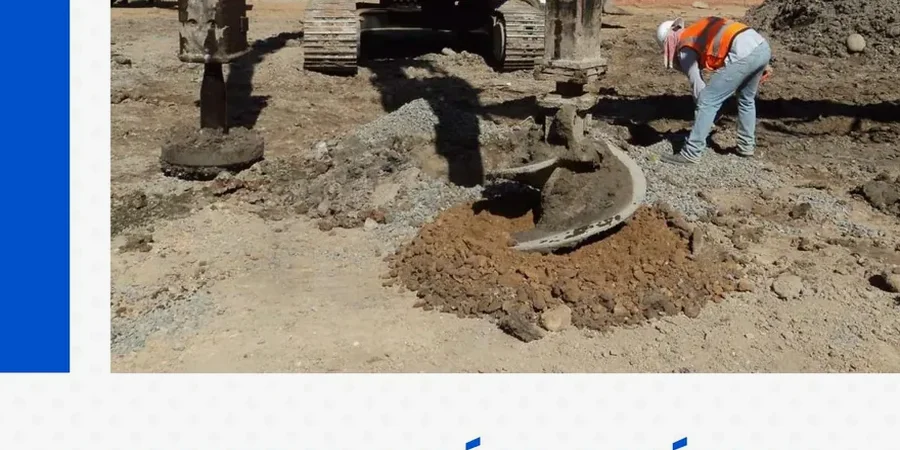
This category serves a wide spectrum of projects, from single-family homes on expansive soils in Briargate to large-scale commercial warehouses in the Colorado Springs Airport Business Park. Infrastructure works, including highway embankments along I-25 and retaining walls for Academy Boulevard extensions, frequently rely on ground improvement to mitigate settlement and enhance global stability. Light industrial facilities and big-box retail stores with heavy floor loads often require treatment to control post-construction settlement. Specialized techniques like stone column design are regularly employed to reinforce soft, cohesive soils, while vibrocompaction design offers a rapid, effective solution for densifying granular fills and loose natural sands across the city's eastern plains.
Available services
Quick answers
What is ground improvement and when is it necessary?
Ground improvement refers to the modification of in-situ soil or rock to increase bearing capacity, reduce settlement, or mitigate liquefaction potential. It becomes necessary when native soils cannot safely support proposed loads, as often occurs with soft clays, loose sands, or expansive shales common in Colorado Springs. The goal is to create a stable, predictable foundation medium without resorting to costly deep foundations.
How do I know which ground improvement technique is right for my site?
The optimal method depends on soil type, depth of treatment required, groundwater conditions, and structural loading. A comprehensive geotechnical investigation is the first step, involving borings, cone penetration tests, and laboratory analysis. In Colorado Springs, techniques like vibrocompaction suit granular soils, while stone columns or chemical grouting may address soft clays and silts beneath proposed structures.
What are the typical regulatory requirements for ground improvement in Colorado Springs?
Projects must comply with the International Building Code as enforced by the Pikes Peak Regional Building Department. This includes submittal of a geotechnical report detailing design parameters and quality control procedures. Field testing, such as plate load tests or post-treatment SPTs, is typically mandated to verify performance meets the design criteria before construction proceeds above the improved ground.
Can ground improvement prevent damage from expansive soils?
Yes, certain ground improvement methods can mitigate expansive soil behavior by altering moisture sensitivity or creating a buffer layer. Techniques like lime stabilization or mechanical mixing can reduce the plasticity index of near-surface clays. However, in highly active zones of the Pierre Shale, ground improvement is often combined with moisture control measures and structural reinforcement for comprehensive protection.