You can't treat the sandy gravels in the Briargate area the same way you'd handle the clayey soils near the Broadmoor neighborhood. The difference in compaction behavior is night and day. A fill that's over-optimized for moisture in one part of Colorado Springs can fail density spec in another part of town just three miles away. That's why a proper Proctor test isn't just a routine lab check—it's the reference curve that the field density crew lives by. For the decomposed Pikes Peak granite we see across much of the Front Range, we typically run the Modified Proctor per ASTM D1557, but the Standard Proctor (ASTM D698) still has its place on low-energy compaction jobs. Before field testing starts, we often pair this with a sand cone density check so the lab curve and the field number are speaking the same language.
A Proctor curve without the zero-air-voids line is like a map with no north arrow—you can't trust the peak until you see the saturation boundary.
Technical details of the service in Colorado Springs
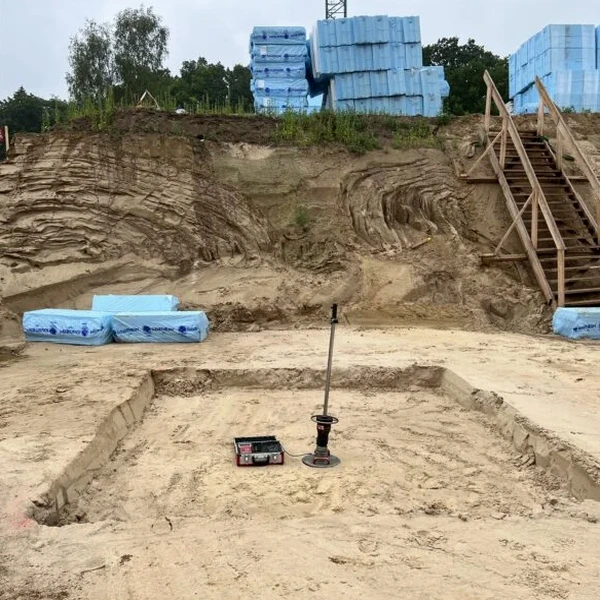
Risks and considerations in Colorado Springs
At 6,035 feet above sea level, Colorado Springs sees freeze-thaw cycles that punish poorly compacted subgrade more aggressively than most engineers from lower elevations expect. The average winter here cycles above and below freezing over 100 times, and each cycle is a miniature heave-and-thaw event that exploits low-density pockets in fill. A Proctor test that's run with the wrong compactive effort—say, Standard when the spec requires Modified—can give you an optimum moisture that's 2 to 4 points higher than what the field crew actually needs, and suddenly your 95% relative compaction target is unachievable without over-wetting the lift. The other risk we see regularly is running the curve on material that's been air-drying on a lab bench for three days while the field crew is placing it at natural moisture. Colorado Springs soils, especially the sandy clays derived from the Dawson and Denver formations, can change optimum moisture by 1.5% just from oven-drying and re-wetting. We prefer to start the Proctor within 24 hours of sampling whenever the spec allows it.
Our services
Our Proctor testing fits into a broader quality-control workflow. These are the companion services that Colorado Springs contractors and geotechnical engineers typically request alongside compaction curves.
Modified Proctor (ASTM D1557)
Full five-point compaction curve using the 10-lb hammer and 18-inch drop. Standard for structural fill, pavement subgrade, and any spec calling for 95% Modified density across El Paso County.
Standard Proctor (ASTM D698)
Lower-energy curve with the 5.5-lb hammer and 12-inch drop. Used for landscape fills, low-height embankments, and utility trench backfill where over-compaction isn't required.
One-Point Proctor / Rapid Check
Single-point moisture-density determination correlated to a previously established family of curves. Ideal for daily QC when the borrow source hasn't changed and you need a same-day pass/fail on moisture conditioning.
Quick answers
How much does a Proctor test cost in Colorado Springs?
Which Proctor method should I specify—Standard or Modified?
In Colorado Springs, most structural fill and pavement specs call for Modified Proctor (ASTM D1557) at 95% relative compaction. Standard Proctor (ASTM D698) is reserved for lower-energy applications like landscape berms, shallow utility bedding, or non-structural fills. Check your geotechnical report—the spec section will name the method and the minimum relative compaction percentage.
What sample size do you need for a Proctor test?
For a 4-inch mold (Methods A and B), we need about 35–40 lb of material. For the 6-inch mold (Method C, used when there's oversize gravel), we need 65–75 lb. The sample should be bagged and sealed immediately after excavation to preserve natural moisture, and delivered to the lab within 24 hours when possible.
How long does it take to get Proctor results back?
A full five-point Proctor curve with the zero-air-voids plot and oversize correction takes 24 to 48 hours from sample receipt. One-point rapid checks on a known material source can be turned around same-day if we receive the sample by mid-morning. We can email the curve as a PDF the moment the lab run is complete.
What is the oversize correction and when do I need it?
When more than 15% of the soil sample is retained on the No. 4 sieve, ASTM D4718 requires an oversize correction. The lab tests the minus-No. 4 fraction separately, measures the bulk specific gravity of the oversize gravel, and mathematically corrects the curve. Without this adjustment, the lab overestimates the maximum dry density of the total material, which can lead to a false pass in the field. It's standard on Colorado Springs projects where decomposed granite is the fill source.