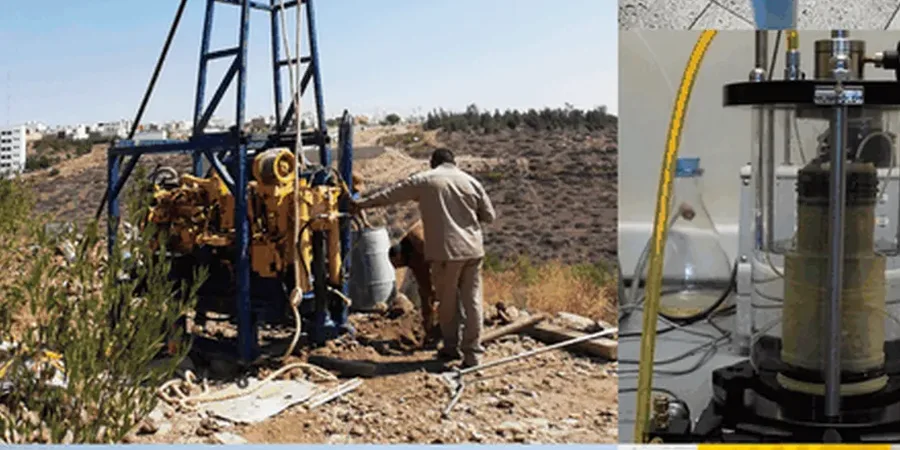
Colorado Springs sits at the base of Pikes Peak, where decomposed Pikes Peak granite transitions into deep colluvial deposits and occasional swelling clay pockets. The freeze-thaw cycles at 6,035 feet elevation accelerate weathering in the upper soil mantle, creating a profile that can mislead standard penetration testing alone. For any engineered structure taller than two stories or any retaining wall exceeding four feet, the City's PPRBD plan review process expects drained and undrained shear strength parameters that only a triaxial test can deliver with defensible accuracy. Our laboratory runs consolidated-undrained (CU) and consolidated-drained (CD) triaxial setups on Shelby tube samples extracted from your borings, giving your geotechnical engineer the Mohr-Coulomb envelope needed to size footings and analyze slope stability across the varied terrain from Garden of the Gods to the Banning Lewis Ranch development.
Effective stress parameters from a CU triaxial test gave us the data to eliminate a tieback system on a 14-foot basement wall, saving three weeks of construction.
Technical details of the service in Colorado Springs
Risks and considerations in Colorado Springs
The most expensive mistake we see in Colorado Springs is using total stress parameters from unconfined compression on soils that lose strength with saturation. A contractor who assumes a cohesive fill will hold a vertical cut based on a pocket penetrometer reading is gambling with trench safety. Several local projects on the west side, where decomposed granite fines can exhibit apparent cohesion when dry, have experienced basement wall movement after heavy monsoon rains in July and August because the design relied on undrained shear strength that vanished once the soil wetted up. A proper CU triaxial program with pore pressure measurement distinguishes real friction from suction-induced cohesion, giving you parameters that hold through seasonal moisture swings. The difference in lateral earth pressure between a φ' of 28 degrees and 34 degrees changes the reinforcing steel schedule by thousands of pounds.
Our services
Our Colorado Springs geotechnical laboratory provides the following triaxial and complementary testing services. Each program is designed around the specific soil type and project requirements.
CU Triaxial with Pore Pressure
Three-specimen consolidated-undrained program per ASTM D4767 yielding effective stress parameters c' and φ'. Includes back-pressure saturation, B-value verification, and Mohr-Coulomb failure envelope with R² fit quality.
UU Triaxial (Quick Undrained)
Unconsolidated-undrained testing per ASTM D2850 for rapid assessment of undrained shear strength in fine-grained soils. Suitable for preliminary bearing capacity estimates on clay sites when time is constrained.
CD Triaxial (Drained)
Consolidated-drained testing with strain rates slow enough to dissipate pore pressure. Critical for long-term stability analysis of cut slopes in the Pierre Shale and other overconsolidated formations near the foothills.
Resilient Modulus Triaxial
Repeated-load triaxial per AASHTO T-307 for pavement subgrade characterization. Provides Mr values for Colorado Springs street improvement plans when the DOT requires mechanistic-empirical design inputs.
Quick answers
How much does a triaxial test program cost in Colorado Springs?
What soil types in Colorado Springs benefit most from triaxial testing?
The decomposed granite and colluvial deposits common across the west side and foothills zones often show apparent cohesion that drops sharply when saturated. CU triaxial testing separates true friction from suction effects, which is essential for basement wall design and slope stability in these materials. The interbedded silty clays beneath the downtown corridor also warrant triaxial analysis because overconsolidation from past erosion produces strength parameters that standard correlations can misrepresent.
How many specimens do you need for a full Mohr-Coulomb envelope?
ASTM D4767 requires a minimum of three specimens tested at different effective confining pressures to define the failure envelope. We typically select confining stresses that bracket the in-situ effective stress at the sample depth. For critical infrastructure or sites with highly variable stratigraphy, we recommend two sets of three specimens from different depths to capture strength variability across the soil column before finalizing foundation recommendations.