A pavement section designed for the sandy gravels in Briargate will behave nothing like one built on the claystone-derived soils down in Old Colorado City. That difference — and its price tag — is exactly why the California Bearing Ratio test from a controlled laboratory environment matters here. Colorado Springs sits on a mix of wind-deposited loess, decomposed Pikes Peak granite, and the notoriously expansive Pierre Shale; each of these subgrades demands a different structural number in your pavement design. When our team runs a soaked CBR at 95% of modified Proctor density, we are not just hitting a spec: we are replicating the worst-case moisture scenario that a subgrade in the Monument Creek drainage will actually see after a heavy snowmelt. The result lets engineers size the aggregate base and asphalt thickness with local confidence, avoiding the overdesign that kills budgets north of Woodmen Road or the underdesign that cracks up industrial lots near the airport within two freeze-thaw cycles.
A soaked CBR value of 4 versus 8 on the same subgrade can mean the difference between a 6-inch aggregate base and a 12-inch one across an entire subdivision.
Technical details of the service in Colorado Springs
Risks and considerations in Colorado Springs
The IBC references AASHTO pavement design methodology, and the City of Colorado Springs Engineering Development Standards specify a minimum design CBR for residential and arterial streets. Where the risk gets real is in the gap between a field-soaked CBR run on a sunny October day and a true laboratory soaked CBR on a specimen compacted to the same density but tested after full saturation under controlled temperature. We have measured CBR drops of 40% or more in clay samples from the Dawson Formation when the lab soak exposes the soil to moisture levels that a three-hour field soak never reaches. That hidden weakness shows up as fatigue cracking in the asphalt three winters later. By running the test per ASTM D1883 in our temperature-controlled facility, the design captures the subgrade strength at its realistic worst condition, not its best behavior. For projects involving in-situ permeability concerns — like retention pond access roads in the Black Forest area where groundwater can rise seasonally — the lab CBR soaked value becomes the only defensible number to put into the pavement design report.
Our services
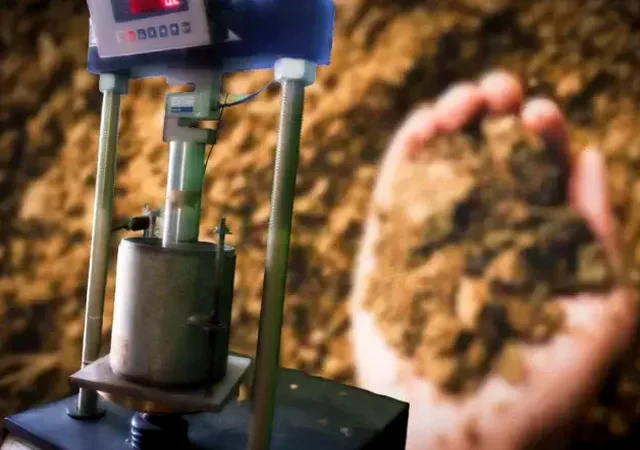
Our Colorado Springs lab performs the CBR test as part of a complete subgrade characterization package. Each test sequence below follows the same logic: compact the soil as it will be placed in the field, saturate it to simulate long-term conditions, and measure the strength that the pavement engineer actually needs.
Soaked Laboratory CBR (ASTM D1883)
The core test for flexible pavement design. Three specimens compacted at varying moisture contents around optimum, soaked for 96 hours under surcharge, and penetrated to determine the soaked CBR at 0.1 and 0.2 inches. Reported alongside the compaction curve and moisture-density relationship for full traceability.
CBR with Swell Measurement
For expansive subgrades common along the Front Range corridor. Each specimen is monitored during the 96-hour soak with a dial gauge recording vertical swell. A swell exceeding 3% in a Pierre Shale sample triggers a recommendation for lime treatment or a deeper aggregate base, long before the pavement goes down.
Unsoaked CBR for Granular Materials
When the design calls for an unbound granular base or subbase evaluation, we run the CBR immediately after compaction without soaking. This gives the immediate bearing capacity for construction traffic and is paired with a grain size analysis to confirm the material meets the CDOT gradation band for Class 6 aggregate base.
Quick answers
How much does a laboratory CBR test cost in Colorado Springs?
Why do I need a lab CBR when a field CBR or DCP test is faster?
Field tests give you an instantaneous reading at whatever moisture condition the subgrade happens to be in that day. The lab CBR controls moisture and density to the project specification, then saturates the specimen to simulate the worst moisture condition over the pavement life. In Colorado Springs, where summer grading moisture can be 5–8% below the equilibrium moisture content under an impermeable asphalt surface, the lab soaked value is the one that prevents underdesign.
What CBR value does Colorado Springs require for residential streets?
The City of Colorado Springs Engineering Development Standards generally require a minimum soaked laboratory CBR of 3 to 5 for residential subgrades, depending on the street classification. If the native soil tests below that threshold, the standard remedies are chemical stabilization with lime or cement, a thicker aggregate base course, or a geogrid-reinforced section — all of which we can help evaluate with follow-up CBR tests on treated specimens.